Introduction to radiologic and imaging sciences and patient care test bank
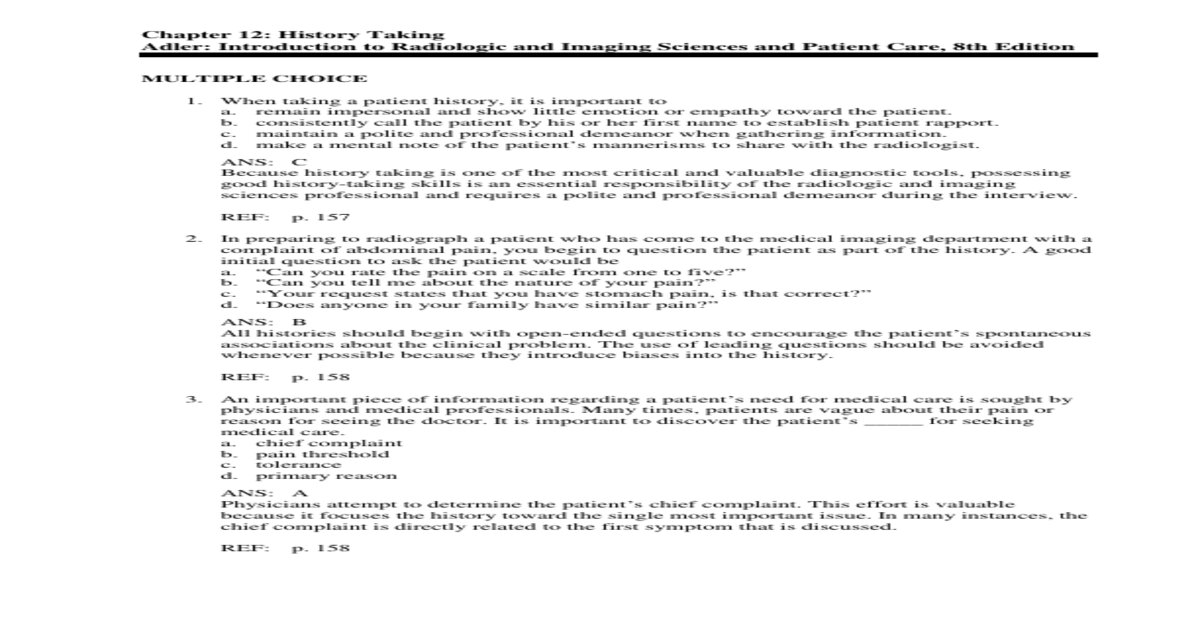
Chapter 12: History Taking Adler: Introduction to Radiologic and Imaging Sciences and Patient Care, 8th Edition MULTIPLE CHOICE 1. When taking a patient history, it is important to a. remain impersonal and show little emotion or empathy toward the patient. b. consistently call the patient by his or her first name to establish patient rapport. c. maintain a polite and professional demeanor when gathering information. d. make a mental note of the patient’s mannerisms to share with the radiologist. REF: p. 157 y R g E g G a I TM ANS: C Because history taking is one of the most critical and valuable diagnostic tools, possessing good history-taking skills is an essential responsibility of the radiologic and imaging sciences professional and requires a polite and professional demeanor during the interview. 2. In preparing to radiograph a patient who has come to the medical imaging department with a complaint of abdominal pain, you begin to question the patient as part of the history. A good initial question to ask the patient would be a. “Can you rate the pain on a scale from one to five?” b. “Can you tell me about the nature of your pain?” c. “Your request states that you have stomach pain, is that correct?” d. “Does anyone in your family have similar pain?” ANS: B All histories should begin with open-ended questions to encourage the patient’s spontaneous associations about the clinical problem. The use of leading questions should be avoided whenever possib
This document contains 194 pages of Healthcare study material from Other. Rated 4.6/5 by 4 students. Instant PDF download available after purchase.
About this document
Chapter 12: History Taking Adler: Introduction to Radiologic and Imaging Sciences and Patient Care, 8th Edition MULTIPLE CHOICE 1. When taking a patient history, it is important to a. remain impersonal and show little emotion or empathy toward the patient. b. consistently call the patient by his or her first name to establish patient rapport. c. maintain a polite and professional demeanor when gathering information. d. make a mental note of the patient’s mannerisms to share with the radiologist. REF: p. 157 y R g E g G a I TM ANS: C Because history taking is one of the most critical and valuable diagnostic tools, possessing good history-taking skills is an essential responsibility of the radiologic and imaging sciences professional and requires a polite and professional demeanor during the interview. 2. In preparing to radiograph a patient who has come to the medical imaging department with a complaint of abdominal pain, you begin to question the patient as part of the history. A good initial question to ask the patient would be a. “Can you rate the pain on a scale from one to five?” b. “Can you tell me about the nature of your pain?” c. “Your request states that you have stomach pain, is that correct?” d. “Does anyone in your family have similar pain?” ANS: B All histories should begin with open-ended questions to encourage the patient’s spontaneous associations about the clinical problem. The use of leading questions should be avoided whenever possib
Specifications
| Institution | Other |
| Subject | Healthcare |
| Course | Introduction to radiologic and imaging sciences and pat... |
Document Details
| Language | English |
| Subject | Healthcare |
| Updated On | Jun 30, 2026 |
| Number of Pages | 194 |
| Type | Exam (Elaborations) |
| Written | 2025-2026 |
| Downloads | 290 |
| Rating | 4.6 / 5.0 (4 reviews) |
Frequently asked questions
Related Study Guides
Trusted by students worldwide
Real feedback from buyers and sellers on Studyrift.
The notes were written in a student's language, not complicated academic style. It helped me compare my own notes and prepare for my exam confidently.
I usually do not have time to go through long textbooks. Having access to organized notes and summaries made a big difference in my preparation.
The notes felt realistic and easy to follow. Not overly complicated or full of unnecessary information. Used them while preparing for my assignments.
Studyrift made studying less stressful. The materials explained difficult concepts in a simple way, almost like a friend was guiding me through it.
I found Studyrift useful because the resources were written in a student's language. It helped me compare my own notes, fill in missing points, and prepare better before submission deadlines.
Studyrift helped me for quick exam preparation. I usually do not have time to go through long textbooks, so having access to organized summaries made a big difference in my scores.
I started using Studyrift to find revision notes but ended up uploading my own materials too. The platform feels simple and student-friendly. My old notes now help other students.
The notes saved me so much time during finals week. I could focus on understanding concepts instead of spending hours summarizing everything from scratch. Highly recommend.
I was skeptical at first but the quality of notes surprised me. They were detailed, well structured and matched exactly what my professor was testing. Definitely using Studyrift again next semester.
What I liked most was that the notes felt realistic and easy to follow. Not overly complicated. I used a few resources while preparing for assignments and they really helped me pass.
Students also bought

Why students choose Studyrift
Quality verified by real buyers
Not satisfied? Get a full refund
No waiting, access immediately
256-bit SSL encrypted checkout
All reviews from real users after verified purchases
- ✓ Instant access after payment
- ✓ Download as PDF — 194 pages
- ✓ 30-day money back guarantee
- ✓ Secure payment
- ✓ Access anytime from any device
Students also bought
Similar documents from the same subject and institution